
Criminal Cases in the Graham County Courts
Graham County criminal court cases do not all live at one counter. The Graham County Superior Court is the county court of record for felony trial proceedings. The Clerk of Superior Court dockets filed documents and keeps the official file. Graham County Justice Court handles criminal traffic, misdemeanor criminal matters, and the first stages of felony cases. City matters may remain in Safford City Court or Thatcher Municipal Court when they arise from local citations or city officers.
The court named on the docket controls where a reader should ask for records. A Graham County Justice Court file may show an initial appearance or preliminary hearing, while the later Superior Court file contains the felony charging papers, motions, trial events, judgment, and sentence. Municipal files can include citations, city misdemeanors, trial settings, payment history, and failure-to-appear warrants. Court identity is therefore as important as a party name or case number.
The county's official Superior Court page shows where public-access questions are routed. The source view below provides a clear starting point for Graham County criminal case records.
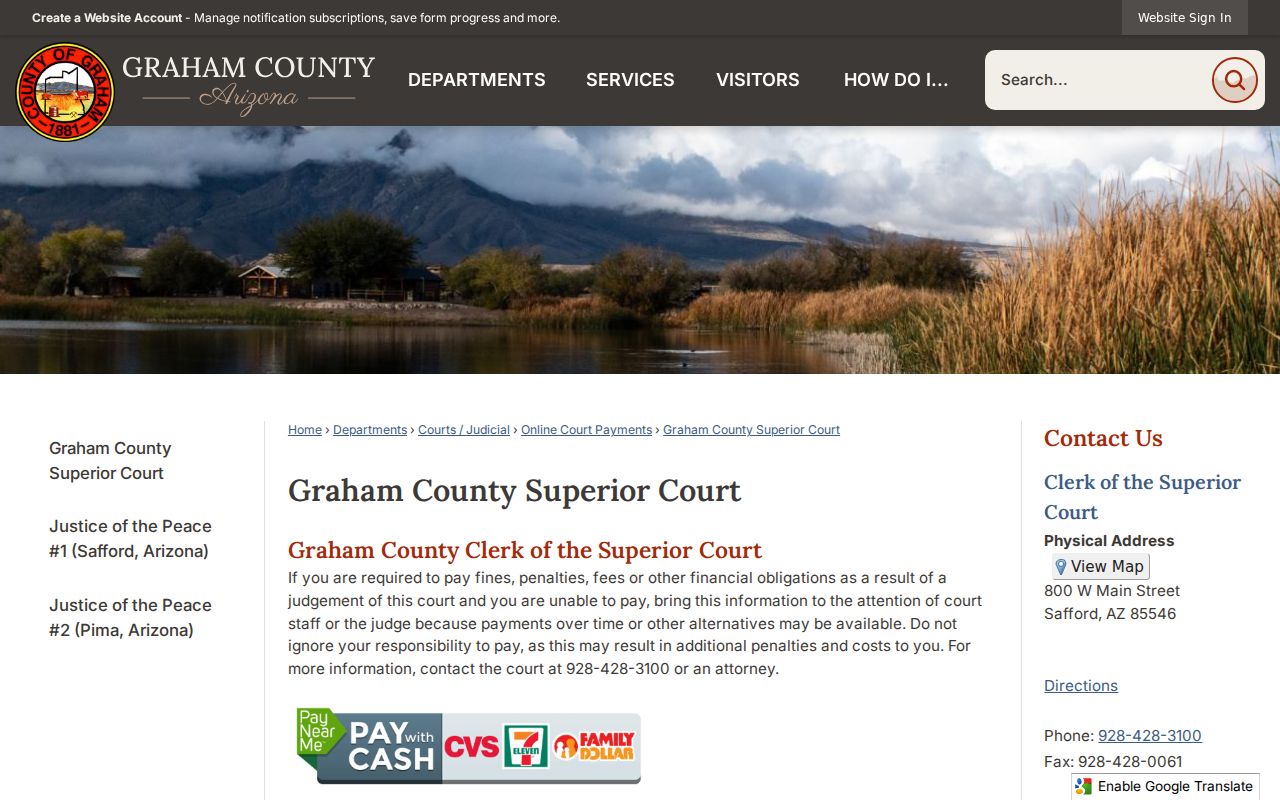
That page points record seekers back to the Clerk, which is the custodian of the filed Graham County case record.
Graham County Criminal Court of Record
The main Graham County court-record counter is at 800 W. Main Street in Safford. The Clerk of Superior Court works from the first floor of the courthouse and is open Monday through Friday from 8 a.m. to 5 p.m. The office can be reached at 928-428-3100. It handles public record research, filed documents, copies, appearance bonds, and questions about files that may be confidential. Free interpreters are available.
Calling the Clerk makes sense when an older Graham County criminal case is absent online, when a docket entry does not reveal the actual filing, or when a certified copy is needed. The Clerk says most Superior Court records are public, but some are confidential. That distinction keeps an online omission from becoming proof that no case exists. It may instead reflect a sealed file, a confidential category, a different court, or a document that has not been placed online.
The official Clerk page depicts the local record keeper and its services. The captured page below ties Graham County criminal case access to the office that maintains the source file.
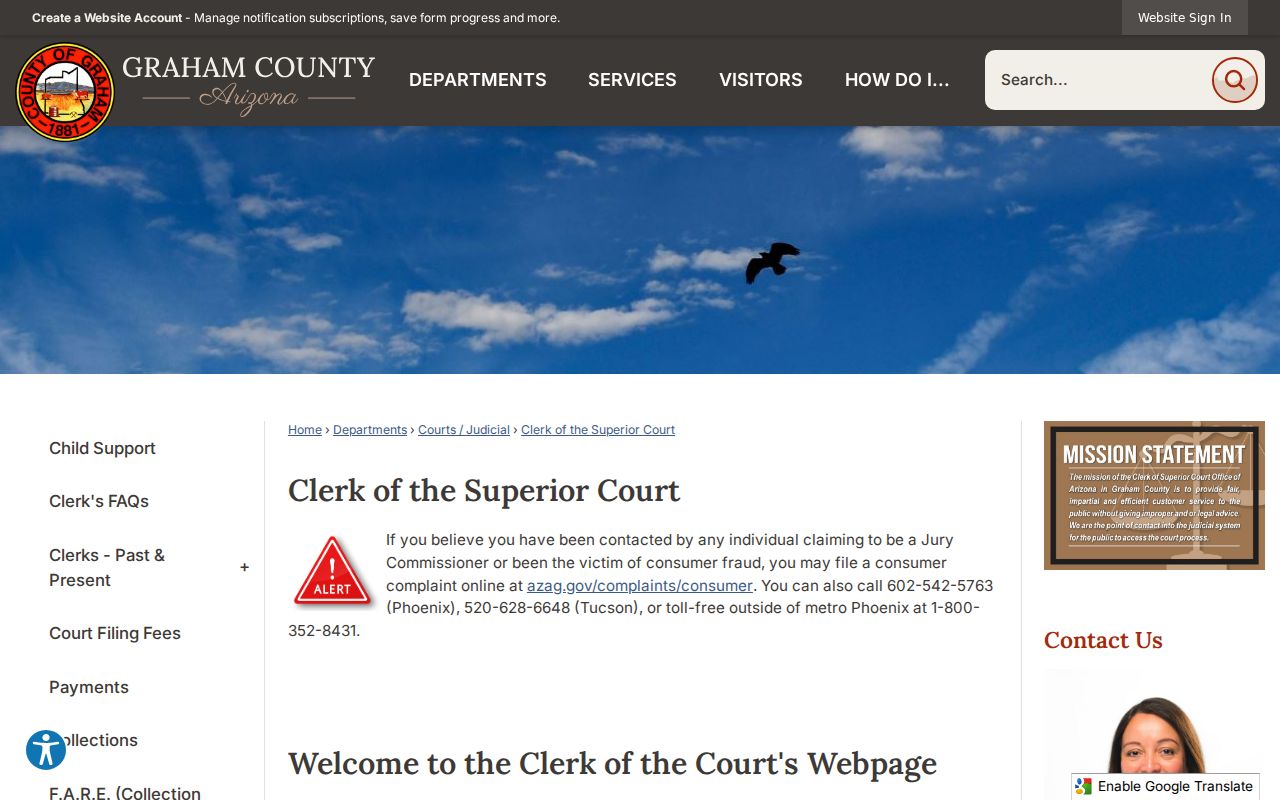
The image reinforces a key rule: use the statewide index to locate a case, then use the Graham County Clerk for the court's authoritative copy.
How to Search Case Records
A Graham County criminal case search works best as a short chain, not a single query. Begin with the Arizona index, confirm the court, and then move to the custodian that holds the documents. Keep spelling variants and an approximate filing year ready. A case number is the best key once it is known because it distinguishes people who share a name.
- Open Arizona Public Access to Court Information and complete its verification prompt.
- Run the case search with the available party or case details, then note the court and case number.
- Check eAccess when the result is a Graham County Superior Court case and document images are needed.
- Contact Justice Court or the proper municipal court when the case began there or concerns a city citation.
- Ask the Graham County Clerk directly for certified copies, older material, or an entry that is not available online.
Arizona Public Access requires the entry controls shown below before a user reaches the search. Its coverage is broad, but the portal itself notes that it covers 177 of Arizona's 184 courts, so a local clerk remains an essential fallback.
| Field Label | Type | Required | Format Notes |
|---|---|---|---|
| Retype characters from picture | CAPTCHA text | Yes | Verification is required before case search |
| Submit | Button | Yes | Runs the verification step |
| Case Search | Tab or page | After verification | Opens the case lookup tools |
| High-volume access | Contact link | No | Separate route for technical or volume needs |
Graham County Case Public Access
Arizona Public Access to Court Information is the best first index for Graham County criminal court cases. It is free to enter and uses randomly generated verification words. The search result can establish that a public case exists, identify its court, and provide the case trail available through the participating court. It should not be read as a substitute for every pleading, minute entry, or signed order in the clerk's file.
The official portal entry page is shown in the source capture below. It helps explain why a Graham County case search cannot be automated or treated as a bulk name list.
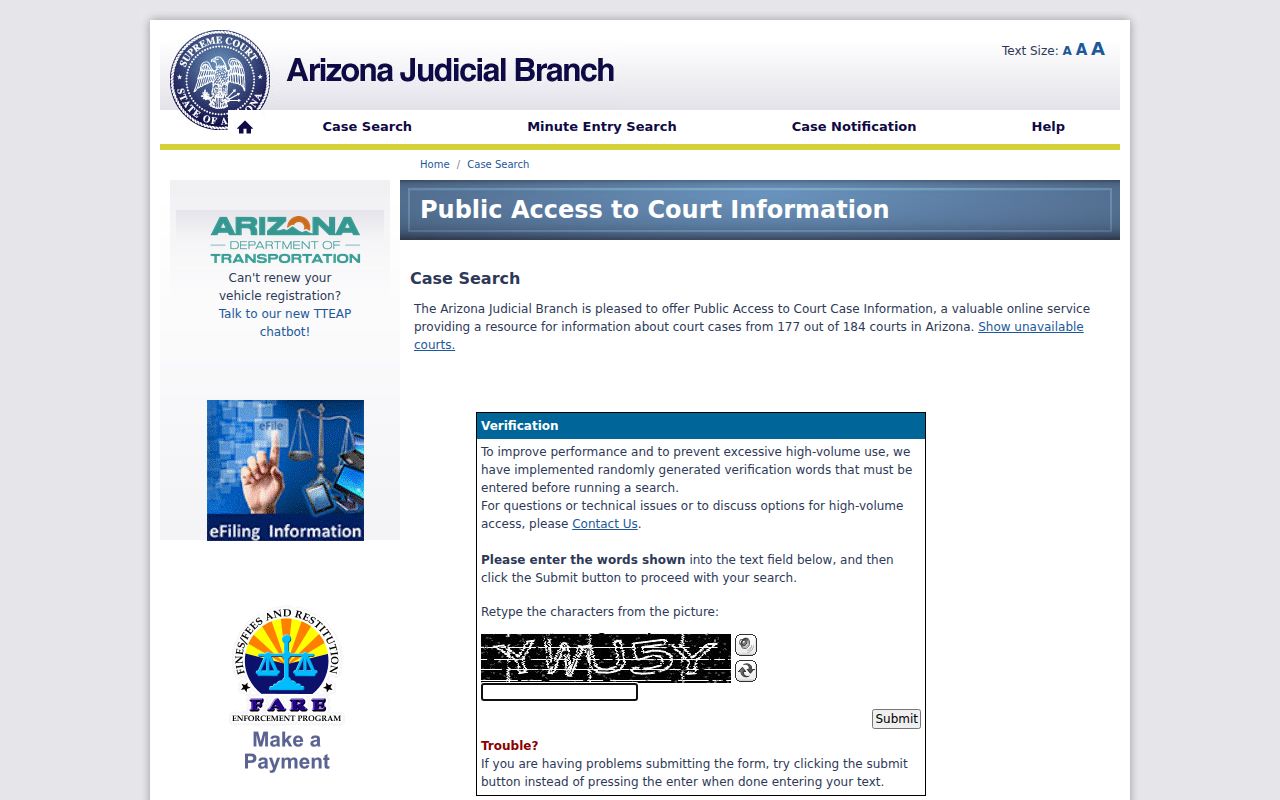
After verification, record the exact case number and court name. Those two details make later requests to the Graham County Clerk, Justice Court, or a municipal court much more precise.
Note: A statewide index result identifies a case trail, while the local clerk controls copies and answers about restricted files.
What the Case File Shows
A Graham County criminal court file records what prosecutors filed and what the judge did. It may show a complaint, information, or indictment, followed by hearings, motions, pleas, minute entries, judgment, and sentence. The initial allegation can change as counts are amended or dismissed. For that reason, the final disposition must be read beside the charging document rather than inferred from the first charge.
| Case Number and Court | Identifies the Graham County court file and the office that holds it. |
|---|---|
| Charging Document | Shows the complaint, information, indictment, or citation and the counts filed. |
| Docket Entries | Lists filed papers, minute entries, motions, orders, and case activity. |
| Hearing Dates | Tracks appearances, arraignment, pretrial events, trial settings, and sentencing. |
| Disposition and Judgment | States whether counts ended in dismissal, acquittal, plea, or conviction. |
| Sentence and Conditions | Records custody, probation, fines, fees, restitution, and other court orders when imposed. |
Justice Court can add the first felony-stage papers, including initial appearance and preliminary hearing information. Municipal court files can add citations and city-level payment or warrant activity. A full Graham County court history may therefore require more than one file.
Graham County eAccess Case Documents
When Arizona Public Access confirms a Superior Court case but does not supply the document itself, Arizona eAccess is the next online stop. eAccess is a separate document portal for Arizona Superior Court civil and criminal records where documents are available. Registration or payment may apply to some document access. Graham County readers should use the case number from the index to reduce ambiguity.
The eAccess landing page shown below represents the document layer rather than the general case index. This difference matters when the goal is to read a judgment, minute entry, or filing instead of merely checking status.
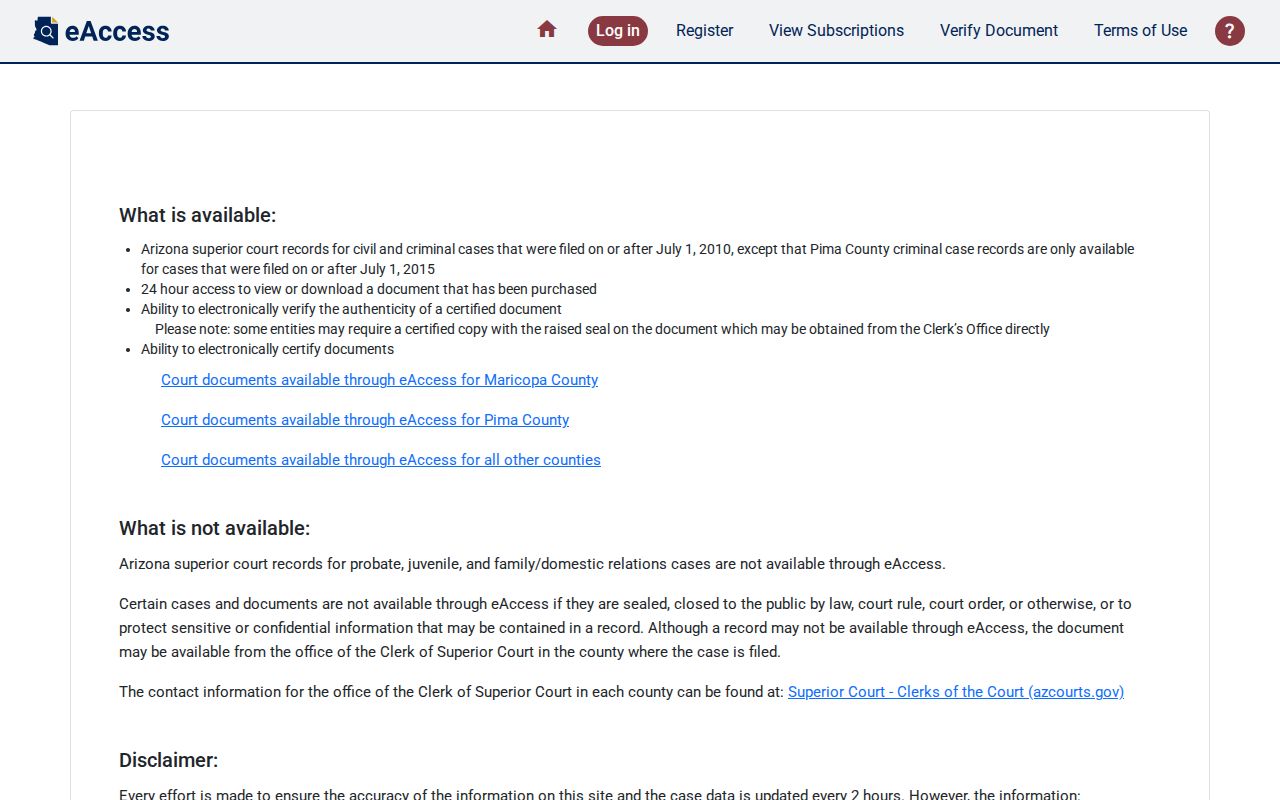
If the needed Graham County document is not offered, contact the Clerk. Do not assume the filing is absent from the official file. Online availability can be narrower than counter access, and confidential or sealed records will not be ordinary public downloads.
Stages of a Criminal Case
The Graham County path depends on charge level. A felony generally receives its initial appearance and preliminary-hearing processing in Justice Court before trial-level proceedings move to Superior Court. Misdemeanor criminal and criminal traffic matters may remain in Justice Court. City citations and city misdemeanors may be handled in the municipal court linked to the issuing officer.
Case flow: Charges Filed › Arraignment › Pretrial › Plea or Trial › Disposition › Sentencing
Each point creates a different part of the Graham County docket. Arraignment records the plea. Pretrial entries show motions, disclosure issues, and settings. A plea or trial resolves guilt on each count, and the disposition states the formal outcome. Sentencing follows a conviction and records the court's order. Reading only the first entry misses later changes that can alter the result.
Graham County Felony Case Path
The Graham County Justice Court explains the local split clearly. It handles felony initial appearances and preliminary hearings, but Superior Court is the felony trial court. That means one incident can produce an early Justice Court record and a later Superior Court file. A reader who searches only the final court can miss the first hearing trail.
The official Justice Court source shown below also identifies its criminal traffic and misdemeanor role. It is located at the same 800 W. Main Street address as the courthouse, but its phone and hours differ: 928-428-1210, Monday through Thursday from 7 a.m. to 6 p.m.
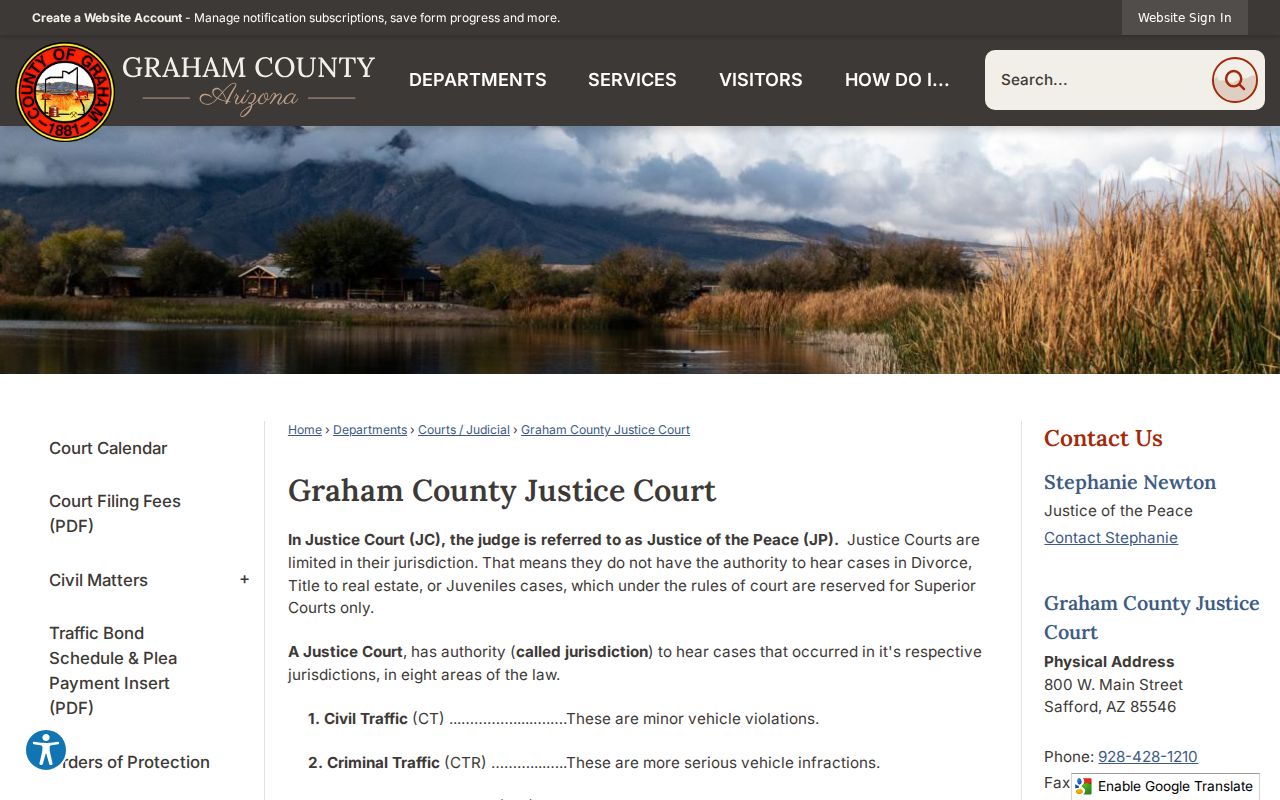
Use the issuing agency and case caption to choose the correct Graham County court. A city citation may instead belong to municipal court, while county or state officer misdemeanors commonly point to Justice Court.
Access & Restrictions
Arizona Public Records Law generally supports inspection of public records, but access is not unlimited. Some Graham County Superior Court files are confidential. Juvenile matters, sealed criminal case records, protected victim information, and material restricted by law do not belong in an ordinary public search. An online docket may also show less detail than the paper or clerk-held file because sensitive fields are redacted.
A.R.S. § 39-121.01 addresses inspection and copies during regular office hours and permits advance payment for copying or postage. Arizona's criminal case sealing law, A.R.S. § 13-911, can hide eligible records from public access after a court grants relief. A set-aside under A.R.S. § 13-905 is a different remedy and does not necessarily hide the case.
Repository records are also different. The Arizona Department of Public Safety Central State Repository does not provide a broad public name search. A person may use the DPS Record Review Packet to inspect their own repository history for accuracy and completeness. That record is not the same as a Graham County court file.
Certified Graham County Case Copies
The Graham County Clerk is the direct source when a plain portal view is not enough. Ask for the specific case number, document title, and filing date if known. A certified copy bears the clerk's formal certification, while a screen view or ordinary printout does not. Current copy and search fees should be confirmed with the Clerk because the captured Graham County sources did not supply a reliable fee schedule for these records.
Federal charges are a separate layer. Graham County federal matters are handled through the District of Arizona, and the U.S. District Court in Tucson is the relevant courthouse source. Federal dockets use PACER, not Arizona Public Access or Graham County eAccess.
The federal courthouse page appears in the source capture below. It shows why a case tied to Graham County can still sit outside every county and state search channel.
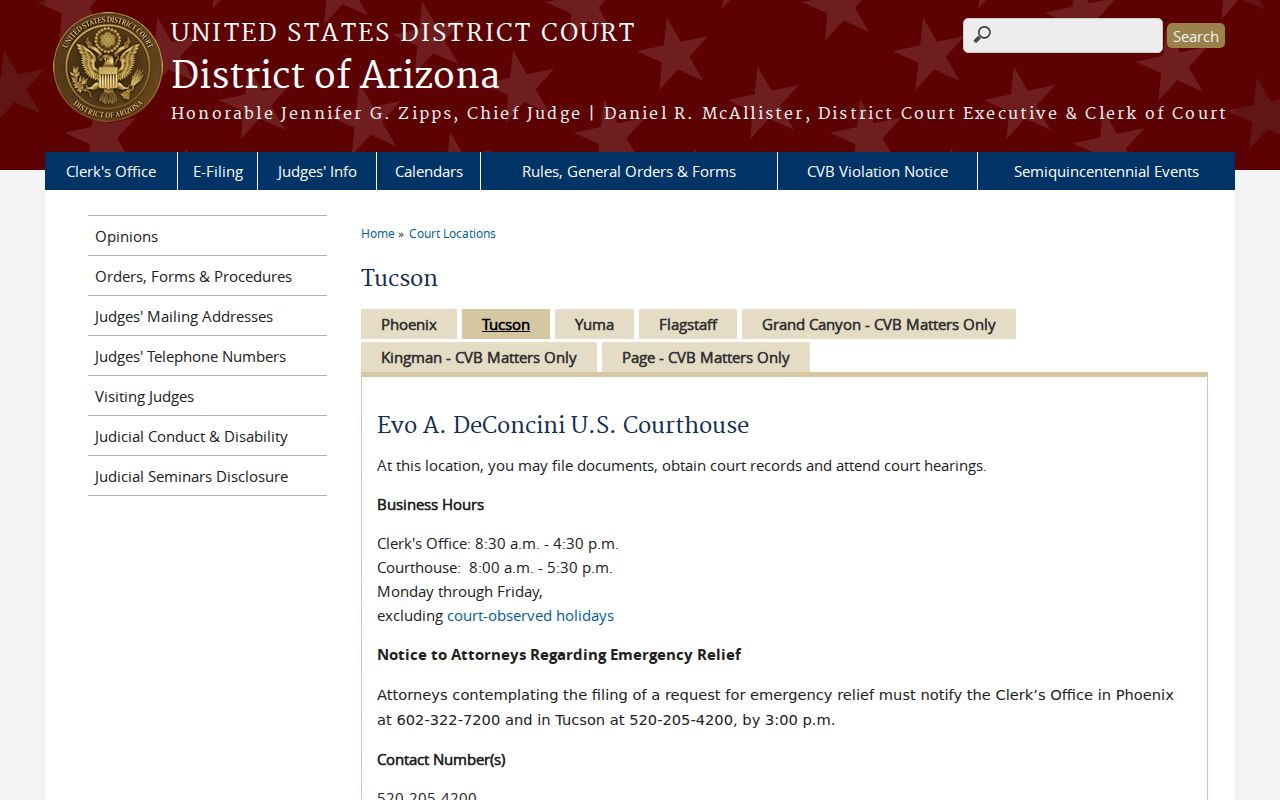
Choose the court system first, then ask its clerk for the official record. This prevents a missing county result from being mistaken for proof that no federal case exists.